The Domain

In the vineyard

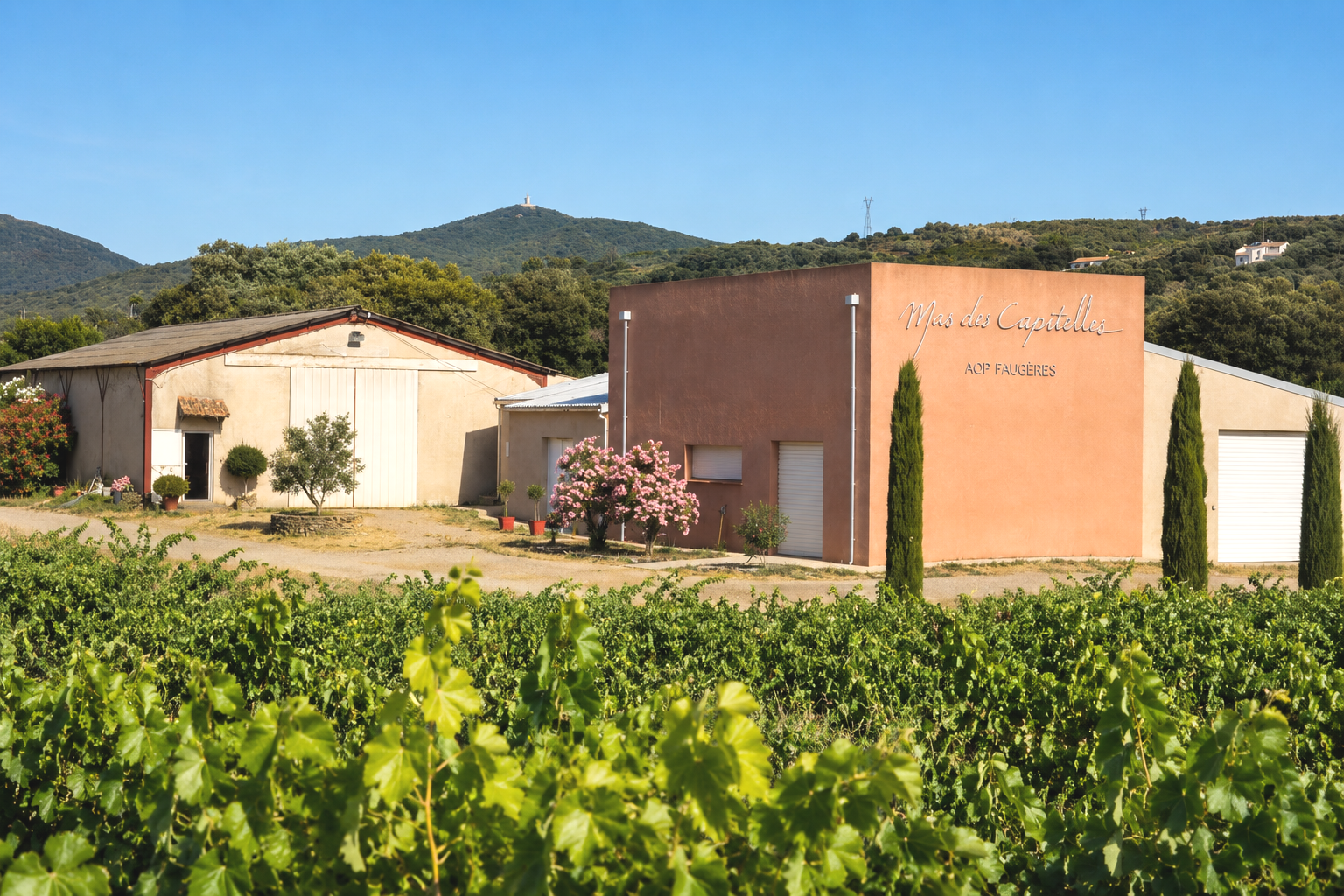
Our vineyard extends over 28 hectares of organically farmed vines in the heart of the Faugères appellation.

The grape varieties are mainly composed of Carignan, Mourvèdre, Grenache, Syrah and Cinsault for our red wines, as well as Roussanne and Vermentino for our white wines.

A large part of our vineyard is made up of old Carignan vines over 60 years old, along with Mourvèdre vines that have been cultivated for several generations on the estate’s hillsides. Yields are naturally modest, generally ranging from 20 to 30 hectolitres per hectare depending on the parcels and vintages.

Throughout the year, we pay particular attention to natural balances, soil vitality and the cycles of living systems.

Through the seasons

The estate’s grape varieties are primarily based on Carignan and Mourvèdre, two varieties that have historically been planted on our schist slopes.

Carignan holds a particular place in our vineyard. Long associated with high-volume wines from the south of France, it reveals a different expression on the dry, sun-drenched hillsides of Faugères, marked by depth, freshness and the ability to age gracefully over time. It is particularly highlighted through our single-parcel cuvée Carignan des Plots.

Mourvèdre is the other pillar of our identity. A late-ripening variety particularly well suited to the Mediterranean climate, it brings structure, complexity and ageing potential. It also plays a central role in our single-parcel cuvées Collection N°1, N°3 and N°4, sourced from the Rec de Sade vineyard.

Convinced that a great wine begins in the vineyard, we pay particular attention to the way our vines are cultivated.

The vines are mainly trained using the traditional gobelet system, adapted to our old vines and schist slopes. The entire vineyard is ploughed in order to preserve soil life and encourage deep rooting of the vines.

Harvesting is carried out by hand, with the grapes carefully selected directly on the vine before picking. This parcel-by-parcel selection allows us to retain only the bunches that have reached the level of ripeness we are seeking.

Farmed organically since 2011, the vineyard is managed with particular attention to natural balances, soil vitality and the cycles of living systems.

This approach is complemented by the use of natural preparations, plant-based decoctions and careful observation of the vine’s rhythms throughout the year.
In the cellar

For the production of our red wines, we have chosen not to use cooling systems.

Harvest takes place at optimal ripeness, generally from mid-September onwards, when nights naturally become cooler. The temperature variation between day and night then allows fermentation temperatures to be regulated naturally.

We observe that these slower, more progressive fermentations encourage a truer expression of the fruit, the grape varieties and the characteristics specific to each vintage.

In this same pursuit of a measured approach, our wines are made with limited use of sulphur, and our red wines are not filtered before bottling. In this way, we seek to preserve as faithfully as possible the expression of the terroir, the vintage and the wine’s natural balance.

The work of time

Carignan and Mourvèdre occupy a central place in our vineyard. Naturally structured varieties, they require time to find their balance and fully reveal their expression.

We have chosen to accompany them through extended ageing periods within our Aion and Etern signatures.

The Aion cuvées, Vintage Blanc and Vieilles Vignes, benefit from a minimum ageing period of two years. This time allows the wine to gain in harmony while preserving the freshness and precision of the fruit.

The Etern cuvées, Primus, Vintage Rouge, Crescendo, Carignan and Collection, are aged for a minimum of five years. This gradual maturation accompanies the evolution of Carignan and Mourvèdre, whose structure slowly integrates over time.

The tannins soften, the balance builds, and each vintage progressively reveals its own personality.

This approach to time has guided our work for many years. It reflects our desire to highlight the expression of the vineyard, the grape varieties and the vintages.

Our heritage

Viticulture has been part of our family’s history for several generations.

Our grandfather, Pierre Laugé, took part in the creation of the village cooperative winery and in the early development of the Faugères appellation. Convinced of the potential of this terroir, he chose to join the cooperative venture, of which he later became president.

A few years later, his son Jean continued this work for more than thirty-five years.

In 1999, with the arrival of Cédric and Brice, the family chose to return to independent winemaking and once again vinify its own grapes by creating Mas des Capitelles.

Today, we continue this family and artisan approach, personally overseeing the vineyard, the cellar and the ageing of our wines, in order to pass on this heritage to future generations.